TROOPER
September 16- October 21, 2026
Opening reception Wednesday, September 16, 3-6pm
On William Blake’s Ghostbusting Paintings
by Christian Viveros-Fauné
Brooklyn, New York
Politics is the art of the possible, but art creates the possible of the politics.
—Ta-Nehisi Coates, The Message
Taboos are made to be broken.
This was my first thought on seeing digital reproductions of William Blake’s conspicuously academic, 19th century-inspired, American history paintings. Featuring variously scaled depictions of a single U.S. Army issue McClellan Saddle, an obsolete piece of military technology that synopsizes nearly two centuries of American power, Blake’s representations of the decommissioned mount stack up as sharply focused acts of critical thinking. Paradoxically, the Chicago artist’s paintings also directly flag what they are not: visual synecdoches for a white supremacist aesthetic begat by a John-Wayne-meets-the-National-Garden-of-American-Heroes fever dream.
The freighted history of the McClellan Saddle begins in 1859. That was the year it was adopted as standard army issue and subsequently deployed by generals from George Custer to George Patton; from the U.S. Horse Marines in China to the American cavalry pursuing Pancho Villa during the 1916 Mexico Expedition. A less familiar part of its history: the saddle was used by mounted police in American cities throughout much of the 20th century; presumably to put down civil unrest in cities like Newark, Minneapolis, Los Angeles and Portland—metropolises where, decades later, bronze statues of problem patriarchs like Thomas Jefferson and Theodore Roosevelt were toppled or removed following the 2020 murder of George Floyd.
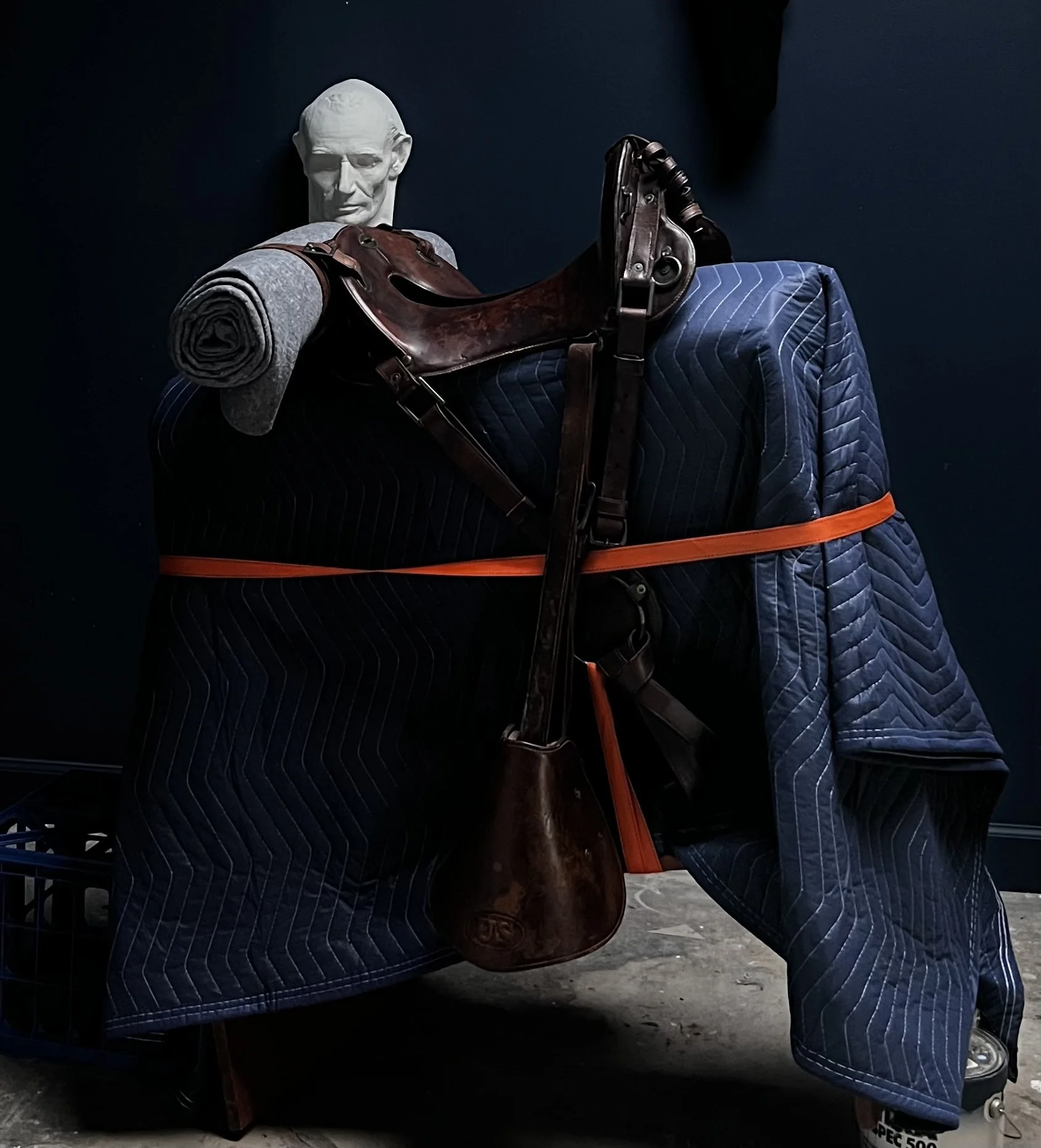
Titled “Trooper” after the saddle’s martial moniker, Blake’s exhibition of twelve narrative canvases at Benedictine University presents the horse chair in question rendered with the precision of a Pieter Claesz skull. Also on view are a painting of a George Washington sword once handled by the abolitionist John Brown, a canvas featuring the head of Apollo Belvedere sporting the Mohawk wig Robert DeNiro wore in the 1976 film Taxi Driver, and four portraits of select riders who also happen to be the artist’s friends and family. The dissonance attending these canvases recalls shoeboxes of compromising family photos. William Faulkner’s idea that the past never dies haunts the works—sometimes, as if stuck on an infinite cycle of rinse and repeat.
Separately and together, Blake’s canvases channel the fine-grained verisimilitude of French Second Empire painting—think of Jean-Louis-Ernest Meissonier’s and Jean León Gérôme’s Grand Manner—but also the more problematic borrowings of l’académie’s American cousins: namely, Confederate-era fantasists like John “Jack” Adams Elder and Conrad Wise Chapman. While France’s Beaux Arts’ movement engendered Art Deco and Modernism, the paintings of Adams, Elders and other illiberal Americans turned visually costive. From post-Reconstruction “Lost Cause” memorials to D.W. Griffith’s racist blockbuster Birth of a Nation to revisionist Westerns like The Searchers, their legacy stalls like a Crohn’s disease for the eye. Time and again, it proves toxic, irritating and highly inflammatory.
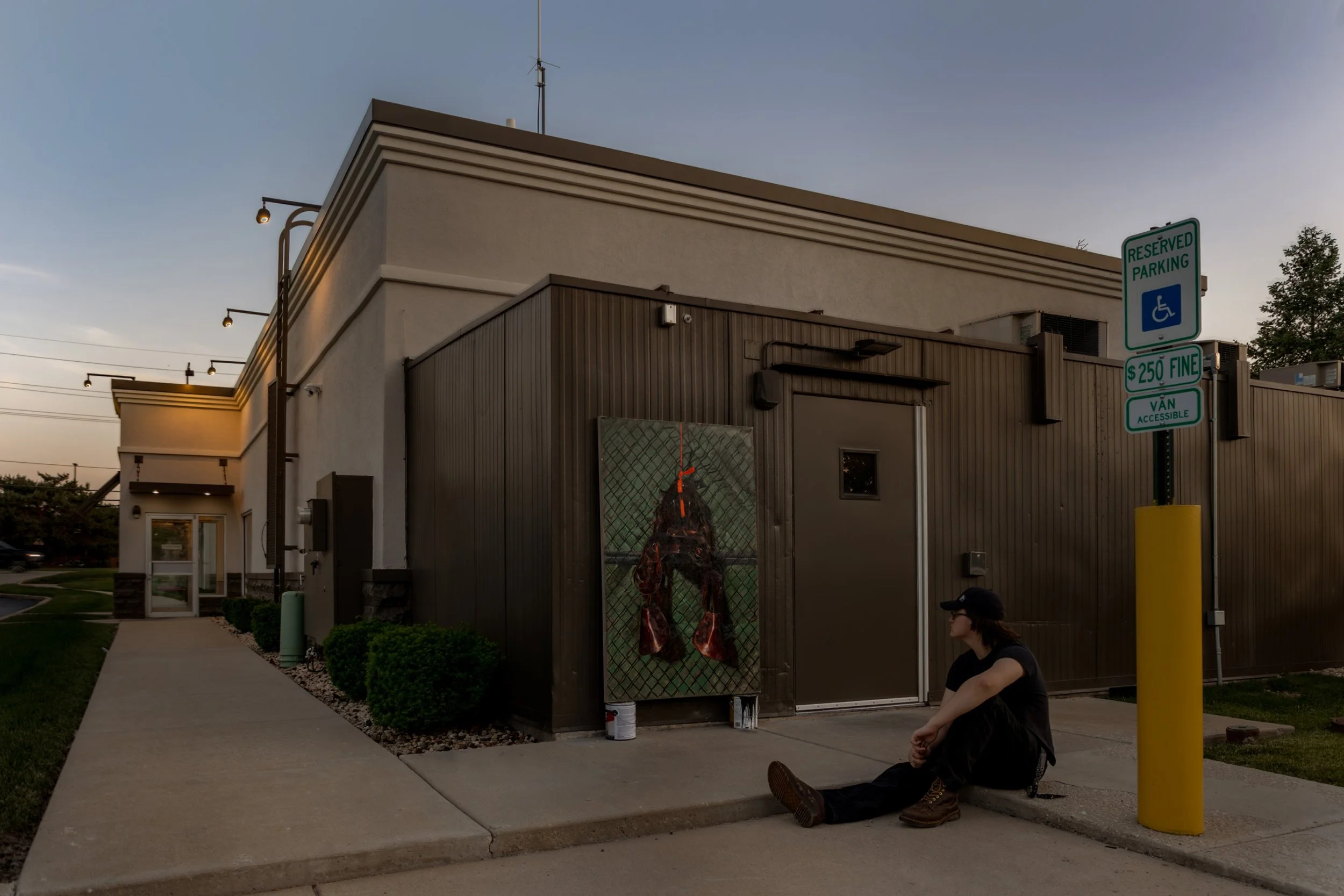
What Blake manages through his skillful adoption of this equivocal tradition is a species of visual jiujitsu. Put differently, his paintings flip the script on an aesthetic worldview capable of seamlessly eliding the following 19th and 20th century ideas: virtue, beauty, classicism, colonial power and racialized pseudoscience. Pictures such as Center Court (2026) and Over the Fence (2026) faithfully represent Blake’s loaded object—the 1904 saddle he purchased from the son of a Chicago mounted police officer in 2025—as a stubborn but anomalous suburban presence. Pictured tied to the chain-link fencing of a village baseball field by strips of orange mesh—instead of, say, flying solidly beneath the haunches of Jim Lassiter in Zane Grey’s Riders of the Purple Sage—its tawny curves assume the form of a paranormal ghost. Blake’s diptych of a saddle seat is similarly ghostbusted. Where his treatment of the matte and reflective properties of leather recalls Baroque still-lifes, his twin canvases reproduce the saddle’s branding: the pictures discordantly read either “US” or “U.S.”
About his portraits, Blake told this writer that he avoided picturing “grown White men” atop the McClellan Saddle; instead, he used his mother, a boy he met at the local historical society (where else?), and his two sisters. Of these, Equestrian Portrait 1 (2026), proves the most compelling case for painting-as-exorcism. A portrait of his 25-year-old sister, Jackie, her bare feet, messy deshabille and direct gaze solidly skewer the once ennobling, now preposterous conventions attendant to paintings of puffed-up men on horseback. At a time when museums are being corrected and censored, Blake’s images question, honor and replenish an artistic tradition of contested but immense value. His revealingly complex figurative paintings refuse to cede ground to Woke Scolds or MAGA Bros. Or as Blake himself puts it: “I make oil paintings using the language of 19th century U.S. painting to see the present.”
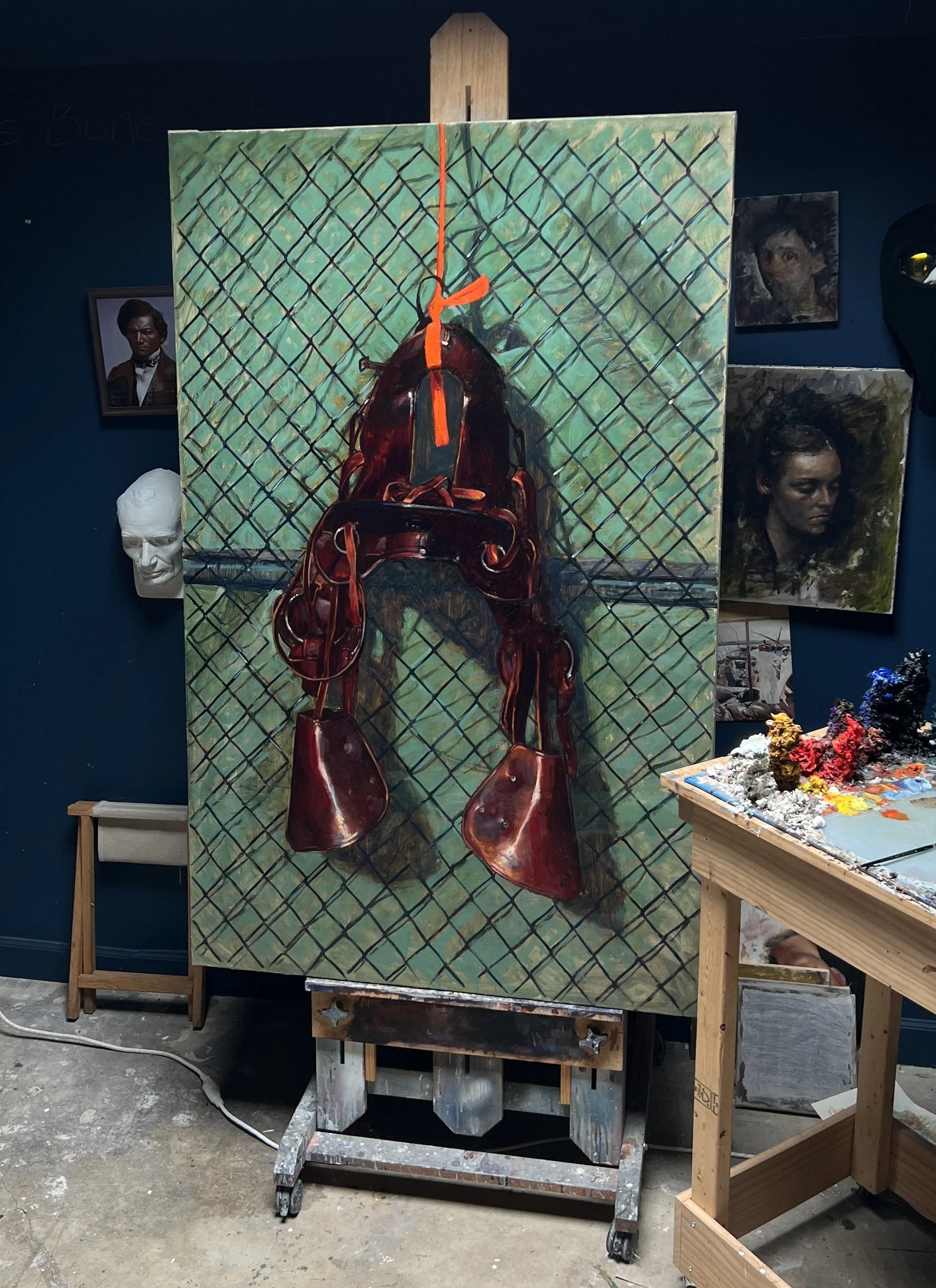
William Blake’s studio| Center Court on easel | Lemont, IL
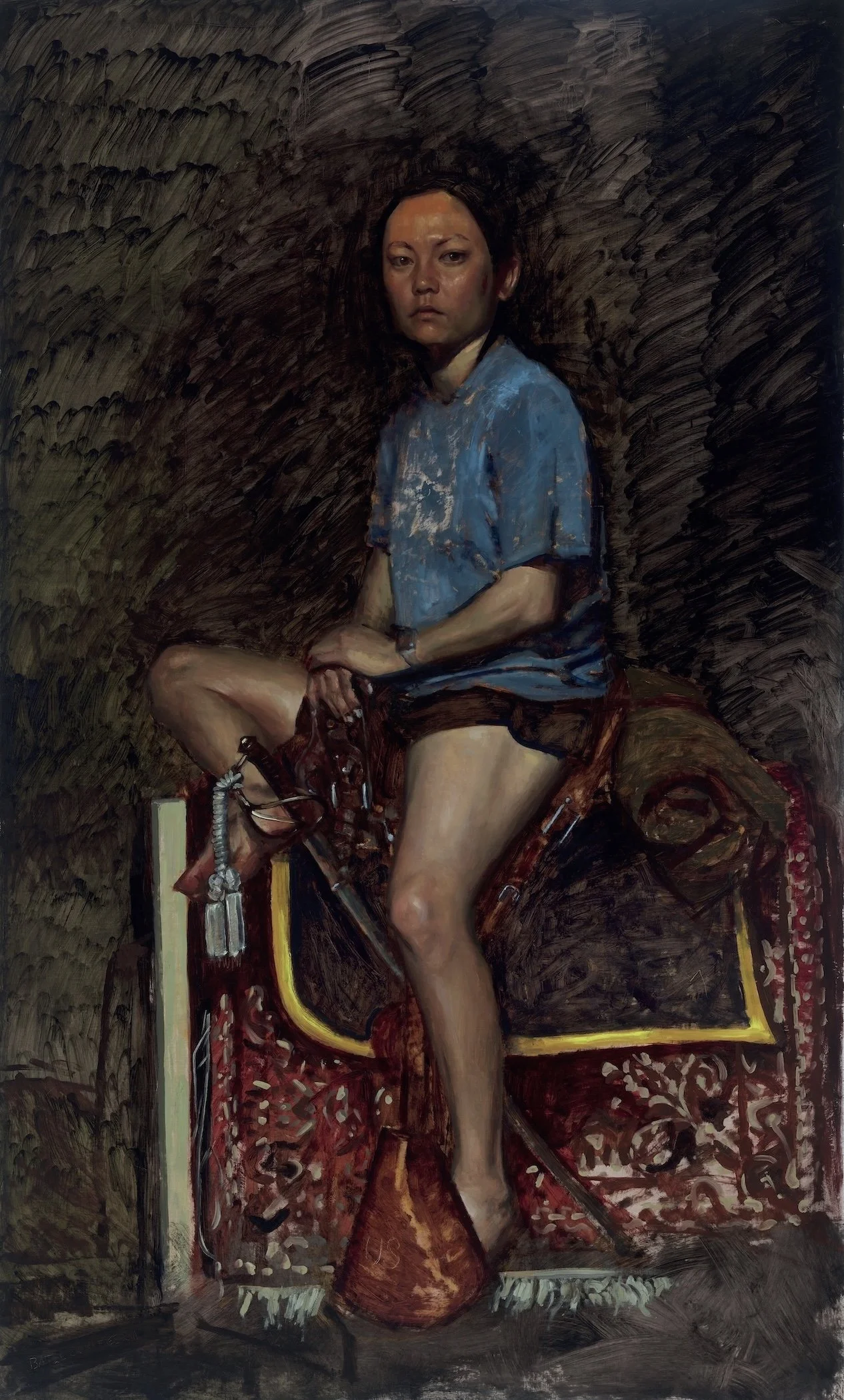
Equestrian Portrait 1 | oil on linen | 70 × 42 inches | 2026